
How to Check Criminal History in Carthage
Begin with the event, not a broad name search. A Carthage officer's narrative, a municipal citation, a detention record, and a criminal judgment are different files. Each may contain facts that the others do not. Write down the full name, event date, location, issuing or arresting agency, and any report, citation, booking, or cause number. Those details keep a Carthage records search focused and help staff find an existing document rather than research an open-ended question.
- Ask the Carthage Police Department for a police-created incident or arrest report. Confirm the request address by phone because two official city pages conflict.
- Search the Carthage Municipal Court portal when the matter is a city traffic, Class C misdemeanor, or ordinance citation.
- Check the Panola County current-inmate interface for recent custody, then call the detention center if an entry may be too new or is absent.
- Move to the District Clerk for a felony file or the County Clerk for a County Court at Law misdemeanor file after charges are filed.
- Use the Texas Department of Public Safety public name search for statewide public conviction and deferred-adjudication information. Use fingerprints to review and verify your own full Texas history.
A blank Carthage result at one step does not settle the question. A Carthage police report can exist without an arrest. A new Carthage booking can precede a court filing, and a Carthage municipal citation does not belong in a felony clerk file. The broader Panola County criminal history overview explains the county and state layers in more depth.
Carthage Criminal Records at New Headquarters
Carthage now lists its Police Department at 453 W. Sabine St., Carthage, TX 75633. The main department number is 903-693-3866. The official department page identifies records, officers, dispatchers, contact material, and complaint information. That address is also used for Carthage Municipal Court, so a caller should state whether the request concerns a police report or a court citation.
The current Carthage Police Department page shows the new headquarters and its contact role. The captured view below helps confirm which current Carthage city page a requester should consult.

The Carthage headquarters matters because Carthage police records and Carthage municipal court records can share a street address without becoming the same record system. Ask for the right Carthage office when calling.
The Carthage Police Department
Carthage Police Department holds the reports its officers create. A useful Carthage written request can identify an incident narrative, arrest report, CAD or 911 material, photographs, or body-camera footage. It should give the approximate date and time, exact or close Carthage location, known subject, and report number when available. Texas body-camera requests have added detail rules, including the date or approximate time, a specific Carthage location, and at least one known subject.
No separate Carthage police request form, copy fee, crime map, arrest blotter, or police app was found in the official sources. The documented records email is mmalone@carthagetexas.com, and the city general number is 903-693-3868. Because the new department page gives 903-693-3866, a requester can call first and ask which channel now handles records. Do not send a city-officer report request to the sheriff merely because a later booking occurred at the county jail.
Two Carthage Police Record Addresses
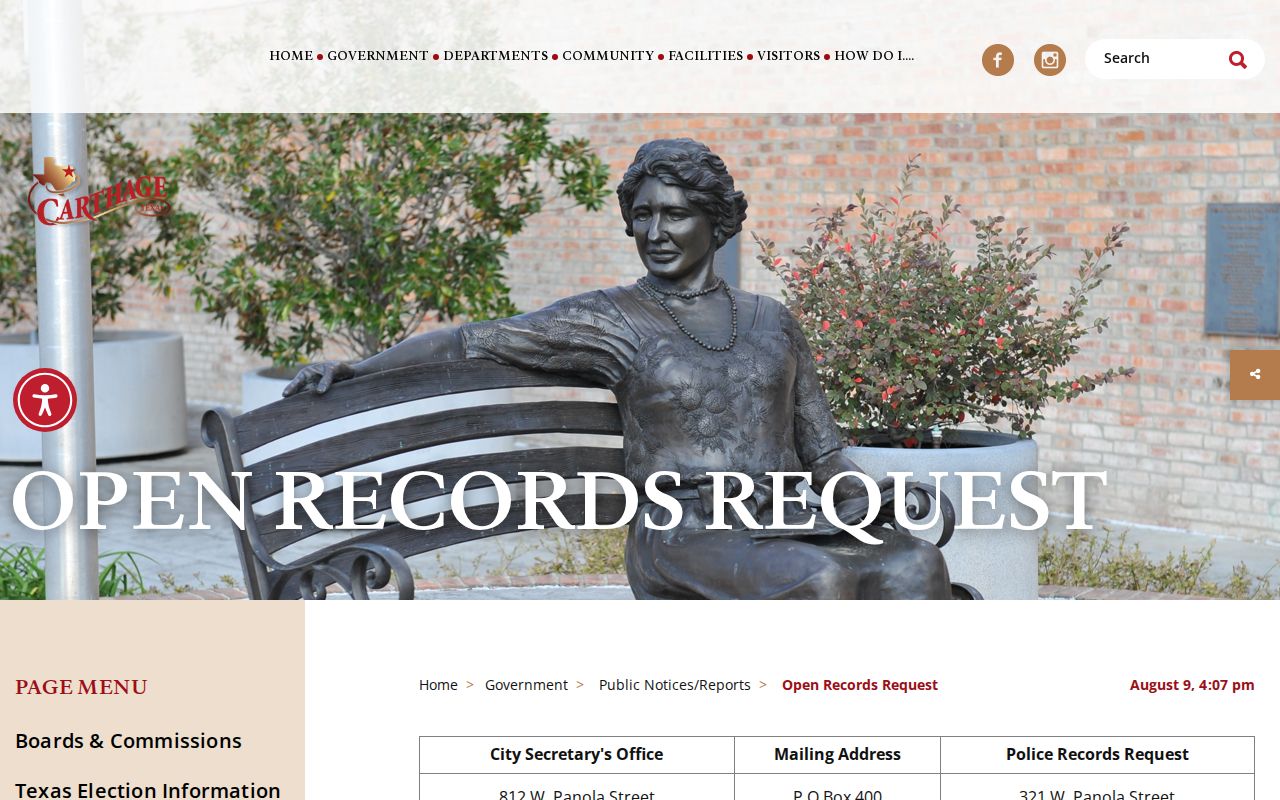
Official Carthage pages do not yet agree on the police address. The current Carthage department page uses 453 W. Sabine, while the Carthage open-records page still directs police requests to 321 W. Panola. The difference likely reflects the Carthage move into the new headquarters, but the published sources do not establish when every Carthage records function moved. The safe course is to call before mailing or visiting.
The Carthage open-records page preserves the older request channel shown in this image.
That Carthage mismatch should not be silently resolved by choosing one address. Confirm the Carthage destination, then keep a copy of the written request and any delivery proof.
Note: Carthage record seekers should verify the police mailing and counter address before a trip because current official city pages conflict.
Arrests and Bookings in Carthage
A Carthage arrest can create a Carthage officer report, intake record, photograph, fingerprints, charge and bond entries, a magistrate record, and later a court case. The Carthage arrest charge is an accusation. Prosecutors can reject it, reduce it, or file a different charge. The Panola County current-inmate system can show Carthage custody, charges, and arresting agency, while the officer narrative remains with the Carthage agency that made the arrest.
No official city jail page or published booking agreement was located for Carthage. The Panola County Detention Center and its current-inmate portal are the documented fallback, but not every Carthage Police Department arrest should be stated as booked there without confirmation. Call the detention center at 903-693-0359 when recent custody is the key question. For the full booking and court sequence, use the county's arrest history channels.
Carthage Citation Numbers Changed in 2026
Carthage changed how citation numbers work in its online search. A Carthage citation issued before January 1, 2026 needs the letters PD before its number. Carthage citations from 2026 forward use the numeric number alone. This small format rule can explain a false blank result, especially when a person enters an older Carthage paper citation exactly as its bare digits appear.
The official Carthage citation search offers several search modes and displays the public interface captured below.
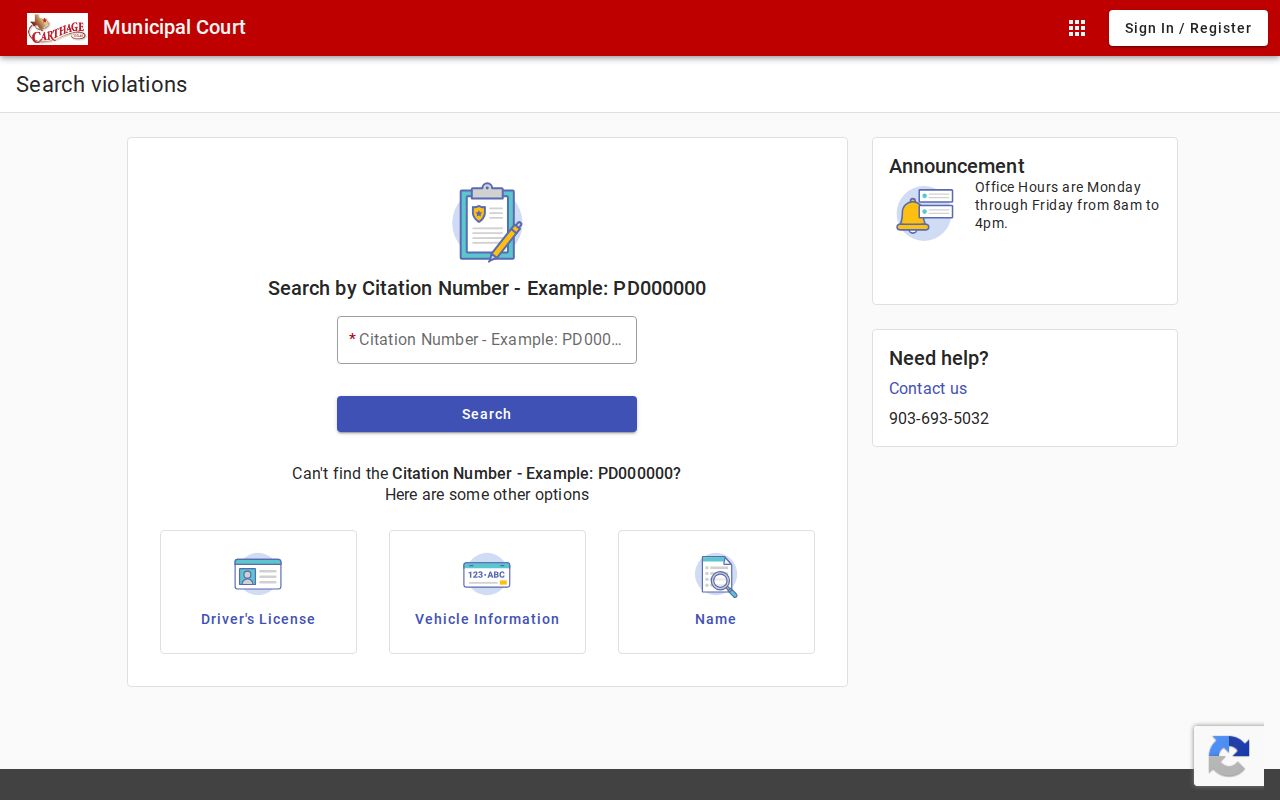
Carthage searchers may use a citation number, driver's license and date of birth, vehicle plate and state, name and date of birth, or business name. The Carthage form also exposes a Social Security number mode, which should not be used casually on a shared device.
Carthage Municipal Court Records
Carthage Municipal Court handles city ordinance matters, traffic citations, and Class C misdemeanors. It is at 453 W. Sabine, 903-693-5032, and municourt@carthagetexas.com. The counter is open weekdays from 8 a.m. to 4 p.m. Court convenes at 8:30 a.m. on the last Tuesday of each month, subject to holiday-season exceptions. Judge Stuart Lipsey, Clerk Rebecca Rogers, and City Attorney Collin Underwood are the officials named in the research.
| Court Name | Carthage Municipal Court |
|---|---|
| Case Types Heard | Traffic, city ordinance, and other fine-only Class C misdemeanor matters within municipal jurisdiction |
| Case Lookup Channel | Official Municipal Online Payments search, court email, phone, or clerk counter |
| What the Docket Shows | Citation or violation information found through the selected search mode; exact public fields depend on the match |
| Copies & Fees | No city court copy fee was located; Visa, Mastercard, and Discover are accepted through the payment portal |
Municipal Court does not hold a Carthage felony prosecution or a Class A or B misdemeanor filed in county court. Those matters route to the District Clerk or County Clerk. A city citation search is also not labeled as a warrant list. Call the court to verify the current status and required response.
Carthage Arrests Versus City Convictions
A city officer may make an arrest for conduct that later becomes a county prosecution. By contrast, the Carthage Municipal Court resolves fine-only matters within its jurisdiction. The badge on the first report does not decide which court will hold the final case. The level of the filed charge does.
| Record | Carthage Starting Point | Later Destination |
|---|---|---|
| Police incident | Carthage Police Department | Stays with police unless used in a filed case |
| Fine-only citation | Carthage Municipal Court | Municipal docket and disposition |
| Custodial arrest | Arresting agency and booking facility | County clerk file if a charge is prosecuted |
| State history entry | Reporting agencies and clerks | Texas Department of Public Safety |
Where Carthage Records End Up
A Carthage officer creates the local incident or arrest report. A booking facility creates the custody file and sends fingerprint-supported arrest data through Texas reporting systems. If a prosecutor files the accusation, the District Clerk keeps the felony case or the County Clerk keeps a County Court at Law misdemeanor. The clerk and prosecutor later report the disposition to the state system.
Record flow: Carthage Police Department › Panola County Courts › Texas Department of Public Safety
Timing creates gaps between those sources. A booking may appear before a cause number exists. A court dismissal may be in the clerk file before the public state name search updates. For one's own statewide record, TxDPS says fingerprints are the sound way to link identity and address a mismatch.
Carthage Criminal Records and County-Seat History
Carthage has served as Panola County's seat since Jonathan Anderson donated 100 acres in 1848, two years after the county was organized. The old courthouse square became Anderson Park and received that name in 1956. Today's local records offices sit in the same compact city core, though the county clerks are on Sycamore, the sheriff and detention center are on Wellington, and city police and court offices are on Sabine.
The Texas Historical Commission marker record documents that county-seat history and is shown below.
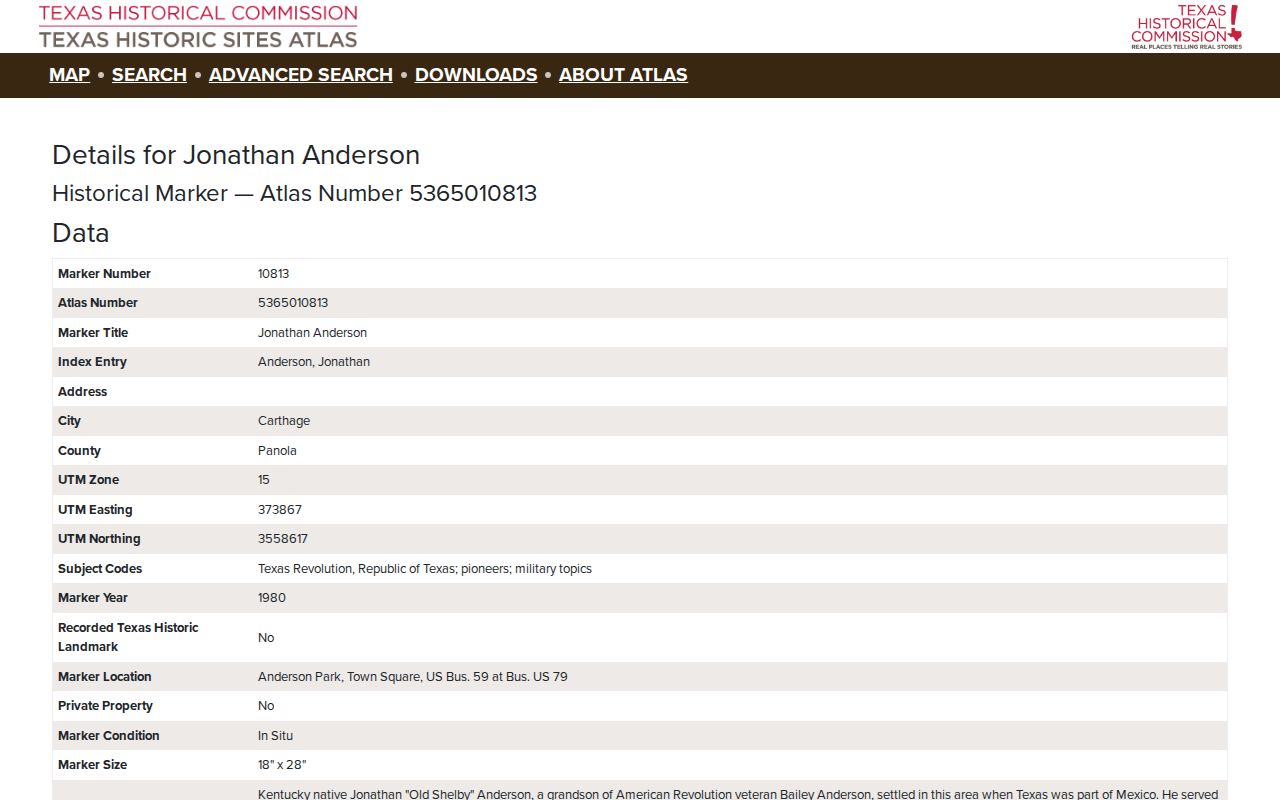
The history explains why older references may point toward the traditional square, while current criminal record counters use several nearby addresses.
When Carthage Criminal Records Do Not Match
First check the record type and number format. Add the PD prefix to a pre-2026 Carthage citation. For a police report, confirm the incident date, location, and agency. For an arrest, compare the arresting agency shown by the jail with the office that received the request. For a filed charge, ask the right county clerk to search the cause number and filing date.
A no-match can also reflect a reporting delay, name variation, older offline file, expunction, nondisclosure, or another lawful restriction. It does not prove that no event occurred. If the record concerns you and a state history appears wrong, compare the local booking and judgment with a fingerprint-based TxDPS personal review before seeking a correction.
Note: Keep citation, report, booking, and cause numbers separate because each identifies a different stage of Carthage record creation.
Public Access Rules
A written request under the Texas Public Information Act should go to the Carthage office that maintains the existing record. The city may produce public material, seek clarification, give a cost estimate, redact confidential content, or ask the Attorney General for a ruling. It does not have to answer a question, create a new document, or keep an open request running for records that do not yet exist.
Police and court access do not use one universal rule. Judicial case records remain with their clerks under court-access law. Juvenile information, protected victim details, sensitive identifiers, expunged material, and records under a nondisclosure order can be restricted. State criminal-history dissemination has separate limits.
Key Statutes:
Texas Government Code chapter 552 gives access to existing government records unless law makes them confidential.
Texas Government Code chapter 411 controls state criminal-history disclosure and orders of nondisclosure.
Texas Code of Criminal Procedure chapter 55A sets the rules for expunction of eligible records.